Building the new Fortress Ryukyu

With all the recent news of FC Ryukyu applying for their J1 license, I thought it would be a great time to get some ideas out there for the new stadium. According to what I could find on the internet, FC Ryukyu had plans as early as 2017 to relocate to the Naha area of Okinawa and into a Football only stadium inside a much larger sports/recreational complex.  The stadium itself was supposed to be a “J1 ready,” 20,000 seat venue, at a cost of around 17 Billion Yen. It was (is?) to be called the Okutakeyama Park Athletics Stadium in Naha City and it was also planned to host Olympics and rugby in the Okinawa Prefecture with aims of opening in 2023.

Well there were some delays, mostly associated with funding, and that project was put on hold. But it is now once again in the forefront and gaining some serious momentum after last weeks revelation that the club will be applying for the J1 license. With that in mind, let’s look at some of those aspects that make a football stadium great with the hopes that this blog comes across the architects’ desk! (Probably not but we can try). I also must give a ton of credit to Mr. Tom Jones, not the singer, for outlining most of these points.
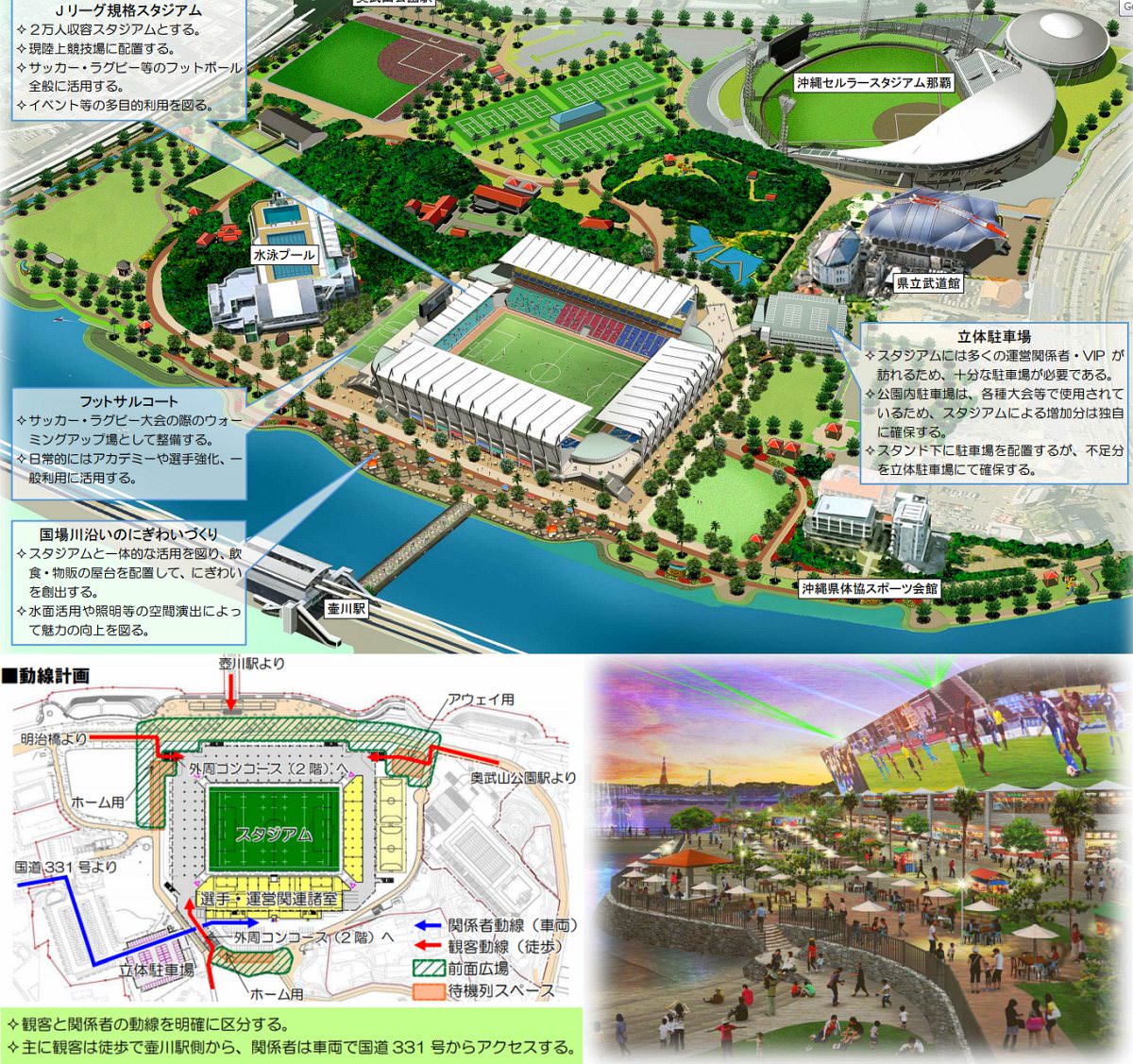
The proposed new stadium for FC Ryukyu circa 2017.

1. The Golden Rule for all Football Stadiums: Get the Front Row of seats as close to the pitch as possible.

I have been in several football stadiums here in Japan, in Korea, in Europe and of course in the U.S.A. for American Football. I have seen both the good and the bad for stadiums and the one thing I can honestly say that I don’t like about Jleague football is; that fans are too far from the pitch in too many of the venues and it decreases the overall atmosphere inside stadiums. The “Tapista,” where FC Ryukyu play is a perfect example. The views from the sections on either side are fine but the fans have a large track between them and the pitch. We are talking about distances of around 30-40 yards. A quick glance at the teams in the J League reveals that out of the 58 teams, J1-J3, 24 play in Football only stadiums (including the U-23 clubs in the J3). The J3 actually has more clubs playing in the football only stadiums, 8, compared to the J2 that has 6. I understand that there are challenges associated with costs to housing a J League team and I hope more clubs in the future will move into football only stadiums.

Seating views from FC Seoul, Ulsan and Suwon.

This year I was lucky enough to get to the FC Ryukyu match when they took on Omiya on the road and it has been one of my best experiences at a football stadium here in Japan. They got everything at the stadium right: Size, Proximity of seating to the Pitch, Large home supporter section at one end of the stadium, food vendors and restrooms. The Nack5 is a great stadium to watch football and would love a carbon copy of that here in Okinawa.
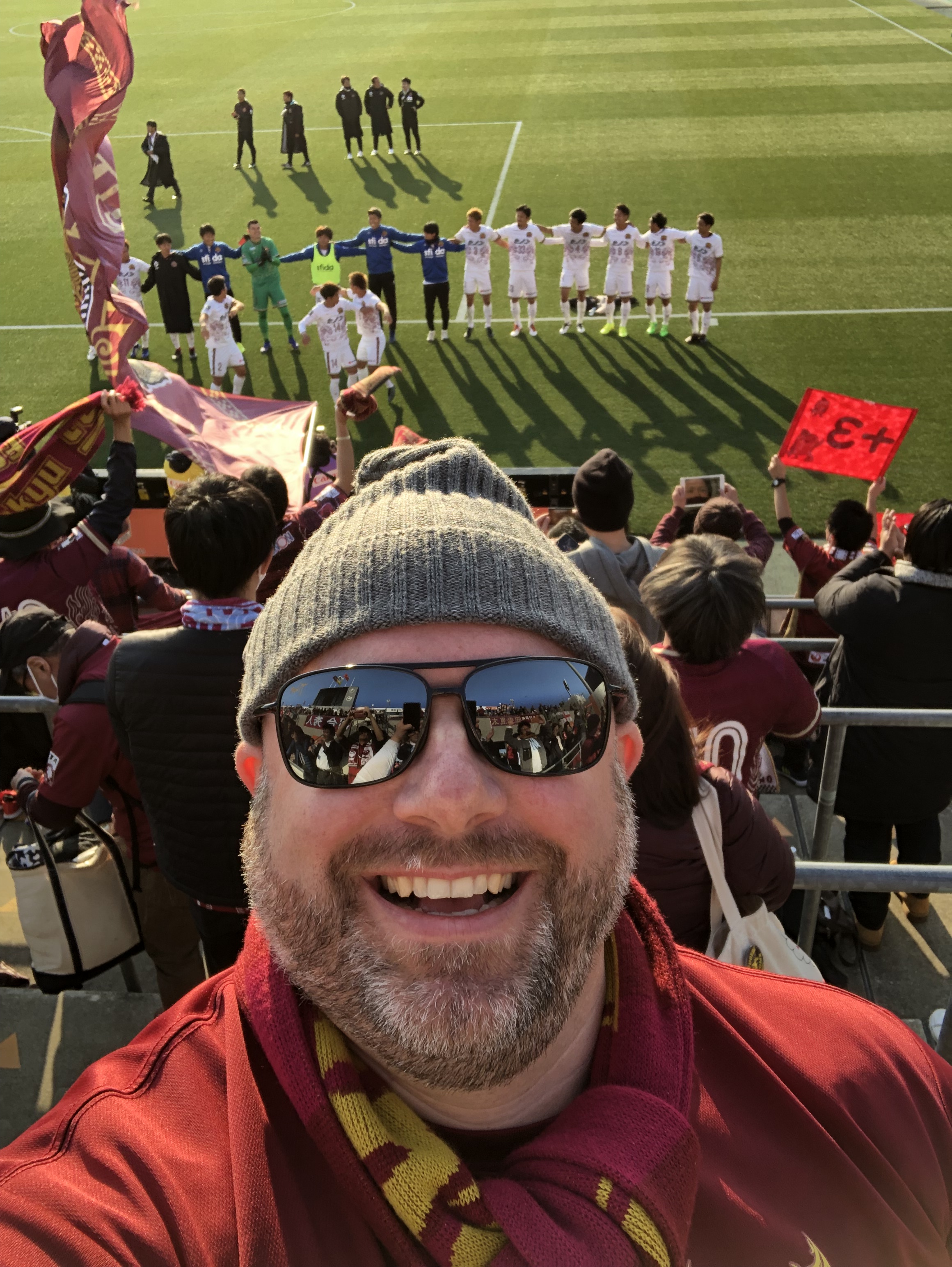
Pretty much one of the best atmospheres I’ve experienced for Football in Asia.

For the new stadium, I hope they recreate something close to the home supporter section at the Nack5 and closer to that of the “Kopp” at Liverpool as this would give F C Ryukyu a serious advantage when playing at home if we could get a section of 6-7,000 people all in one voice.  Because. let’s be honest for a moment, can a multi-sport stadium really generate a great atmosphere for football? In some cases it can, as evidenced by Kawasaki Frontale, but could you imagine if those supporters were closer to the pitch? Whoosh!
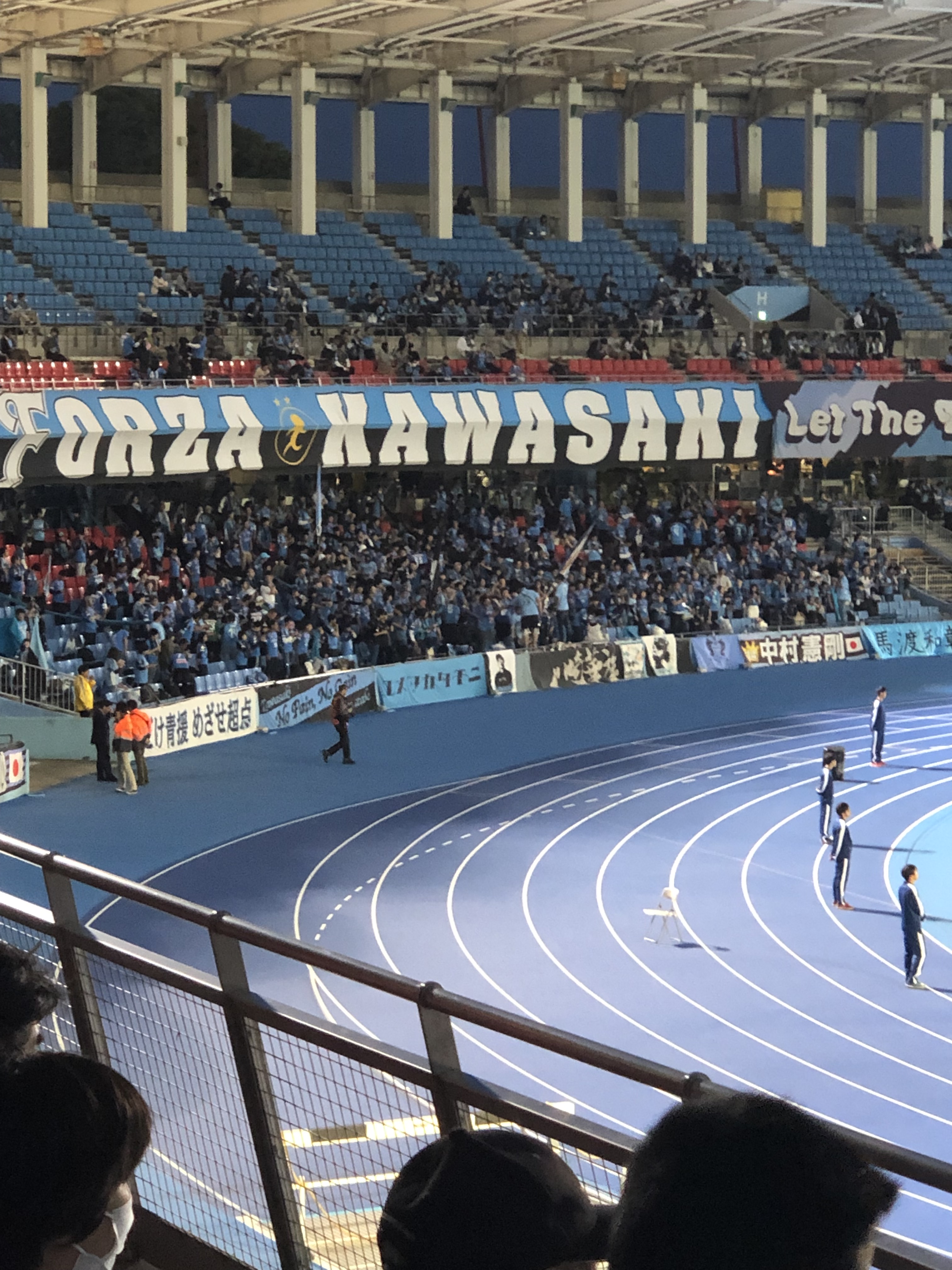
So these Frontale fans made this the best combo stadium atmosphere I’ve witnessed. Can you imagine these fans right up along side the pitch? Would be an even tougher place to play.

2. What are the ambitions of F.C. Ryukyu?

Some might quickly say it is to get to the J1. I would counter, that it is wining titles and building a generational fan base. My father was an Arsenal fan and so are my brother and I and that is because at very young ages he took us to Highbury to experience matches and fall in love with the club. This means that my children will be FC Ryukyu fans as I will do all I can to expose them to the club as often as I can. That’s what FC Ryukyu need to be thinking about here in Okinawa. We’ve seen the challenges of getting 8,000 people to a FC Ryukyu match this season on regular basis, imagine the monumental effort to fill a 20,000-seat stadium for 21, 17 or 25 matches every year. The new stadium needs to build a tremendous atmosphere for all FC Ryukyu fans to connect and come together for the club they love.

Also, there will be costs that arise from nothing as well as those cost associated with the clubs plans so it will largely depend on what FC Ryukyu want to accomplish with the stadium but it is important to understand the best practice for building a stadium and more importantly, how to go beyond it. FC Ryukyu must be involved throughout the entire process so when costs and challenges do arise, they are able to meet them head on and make sound decisions that benefit the club and fan base. There is no “one-stadium-fits-them-all” approach so make this new stadium uniquely Okinawan.

3. Make sure it has places for fans to gather both before the match and after.

Remember, FC Ryukyu are attempting to build an “atmosphere” both inside and outside the stadium. Considering the home supporters need to show up 3-4 hours prior to kickoff to hang banners and flags, fans will start arriving at the stadium well in advance of a match.

I’d love to see the new stadium have one of the following. A large open area at one of the corners of the stadium on the second or third level where fans could gather and watch the match together. The other would be a large sports bar inside the stadium with large screen TVs broadcasting the match. I’ve been to plenty of stadiums where this is the case and not every fan wishes to sit in their seat each match. Plus, you’d be able to sell tickets to either the seat or the special viewing areas.

Hopefully there will be a large enough parking area to do some tailgating but we’ll get to that in another section. After the match, it would be important not to push the fans out of the stadium if food, beverage and merchandise vendors are still open. If people need to exit the stadium, then hopefully there are some merchandise tents/shops outside the stadium as well as places to purchase food and beverages.

FC Ryukyu should take the steps now to track when fans start showing up to the Tapista. Break it down by arrival and departure times as well as by estimated numbers of people to get a better understanding of the venues to offer the fans.

4. Technology will be key for the new stadium.

This goes without saying but the new stadium needs free WiFi. Second, the sound and lighting systems need to be of high quality and so does the scoreboard. If it is impossible to broadcast the match live outside on large screen TVs, then at least an audio broadcast of the match outside of the stadium should be there to drive interest for the passerby who doesn’t have a ticket to the match.

One radical idea, and I have no idea if it is possible, is to have seats that can change color to the opposing teams’ supporters in the opposition section. We all know that JLeague rules stipulates that there must be seats dedicated to the visiting team. Maybe it would give off the appearance of a “fuller” stadium if the seats could match the color of the Home Kit for the opposing team since that is the kit most fans purchase. Not sure that technology exists or the idea has been presented before but anything FC Ryukyu can do from that wild idea to putting a cell phone charging station in each seat would be revolutionary in my mind.

5. Make the Stadium uniquely Okinawa.

I am not sure what this would entail but I think it is important for the stadium to capture this element. It could mean local shops and businesses inside and outside the stadium selling local goods or it could mean the team has dedicated Eisa dancers at every match. Everything about that stadium should look, feel, sound, smell and taste like Okinawa and the Ryukyus.

6. Get the core elements for the stadium right, the first time.

First, everything is based around the live experience of the football match itself. That begins with seating as close and as low to the action as possible. Second, make purchasing tickets easy. This includes both prior to and at the match in multiple languages with cashless ticketing purchase areas (and vendors). Having lived in Okinawa for the better part of 10 years I understand how all of Japan is a cash society, but there will be a large contingent of fans showing up to the stadium that are not used to this way of life, make sure there are ways to support them.

Third, make travel to the stadium as straightforward as possible. The new stadium is intended to be near the monorail and Route 58. Consider the traffic patterns both before and after the match and how the Japanese Prefecture Police can aide in getting the large number of fans out of the parking lot and onto the roads without huge traffic delays. The parking situation must be addressed as parking is a huge issue here in Okinawa. Where will the fans park and will these areas be accessible to daiko’s if fans have had too much to drink?

Fourth, make access to the stadium easier. Prevent long security lines at gates and have several entrances and exits. Fifth, have the best type of facilities in the Jleague. This includes everything from the restrooms, to the food vendors, merchandise vendors inside the stadium and the seating.

Finally, get it right the first time so as not to look back in regret or have to pay a larger cost because lack of foresight.

Conclusion

I have huge expectations for FC Ryukyu, their new stadium and the new proposed training ground. The actions by this club indicate a real desire and plan to achieve some lofty heights here in Japan as well as Asia. The club took the all important step forward last season by gaining promotion to the J2, it is now imperative they enact a sound business plan that sees this club rise into the ranks of the J1 and beyond. That plan can only begin with a brand new, state of the art stadium for FC Ryukyu that grows the fan base and increase revenue.
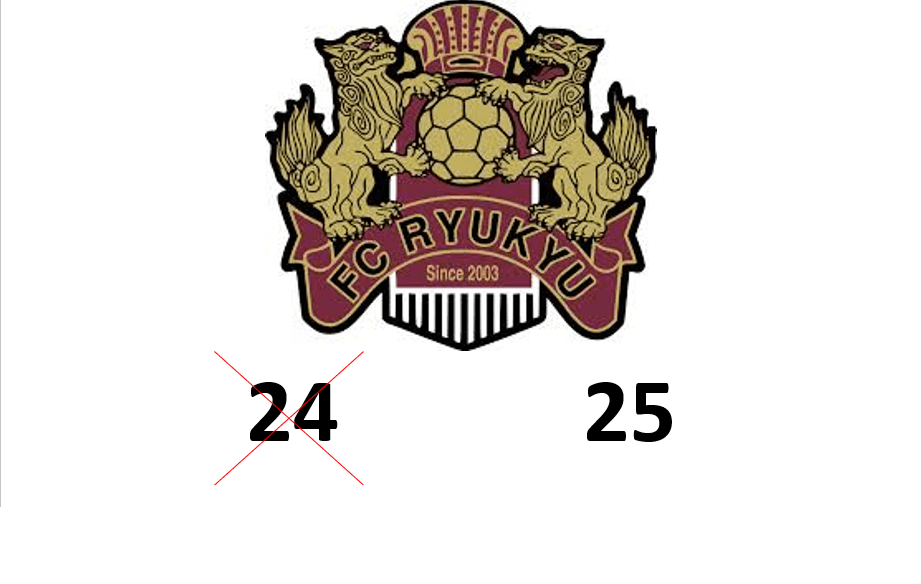
The Streak

There are a few times in the world of sport where one must sit back and admire the achievements of sports franchises even if they are not the one you support. There are all sorts of remarkable achievements such as winning the most titles in the history of a particular sport, winning multiple titles in consecutive seasons and pulling off some ridiculous winning streaks. The latter is the one I want to focus on for today’s entry because it should be near and dear to all FCR fan’s hearts. FCR has now positioned itself to once again to etch its name into the J League history books for the second consecutive week.

FCR currently sits atop of the J2 table with a 24-game J League home unbeaten streak dating back to the 2017 J3 League season. Some may argue that a majority of those games were against lesser competition but I would counter that by saying you can only play the competition in front of you. As a side note, this streak is only for the J League since FCR has lost their initial Emperor’s Cup match at home the past 2 seasons but that discussion is for a later time, for now, let’s focus on the achievement and special moments to date for this record.

The Start: September 30th 2017, special moment indeed as this is my birthday, but seriously FCR faced off against the Under-23 Cerezo Osaka side. The match ended 1-0 after and absolutely top drawer take by # 10 Tomidokoro in the 48’ where he received the ball near the top of the box and sent a beautiful curler around the left side of the keeper.  A familiar face was in the lineup that day besides Tomidokoro as Keita Tanaka made his return to FCR on loan from Mito-Hollyhock.

FCR would then go on to earn consecutive draws against Morioka and FC Tokyo Under-23s, a win against YSCC, draw with Tochigi and finally a win against Kattaler Toyoma on the final match day of the season. Streak started out with 3 wins and 2 draws for 2017.

2018: The streak continued in the opening match of the season with a 4-3 win against Kattaler Toyoma and this was a great match. FCR were up 3-0 at halftime with goals by Yu Togashi, Nakagawa and Uejo and they were cruising. However, the game took an interesting turn at the end as Toyoma made a serious push with 2 late goals to bring the score to 4-3 but it was Uejo’s second goal of the day that proved to be the difference.

Okinawa Ozzy Loses His Cool: There were two matches early on in this streak that really struck a nerve with me as a massive fan of the club because I viewed those matches as must wins. First, FCR squared off against Gainare Tottori, who at the time looked to be one of the stronger teams in the early part of the 2018 J3 League season. I viewed this as a “statement” game that if FCR were serious about doing anything for the season (apparently there were as history has shown) then they needed to assert themselves in this match. FCR twice took the lead against Tottori but it was a goal in the 2nd minute of stoppage time that ended the match in a draw. Now, I wasn’t that upset but slightly disappointed. It was the following match were I kind of had a momentary lapse in judgement due to circumstances beyond my control.

Match Day 6 of 2018 saw FCR taking on the Under-23 Cerezo Osaka team. I viewed this match, along with all under-23 matches that season, as must wins and surely FCR with their players should get the job done against some youngsters. Well the Bengara Boys were done in by another late goal in the 88’ and thus the game ended in a draw. I couldn’t believe that we had only taken 2 points, out of a possible 6, from games that I thought we should’ve won. Had we won the game against U23 Cerezo Osaka I probably wouldn’t have lost it like I did when the team came over to the supporter section after the match to say thanks. I am not proud of my antics, but as passionate fans, we can get very emotional at times. Once the team was in ear shot, I yelled out “that’s not good enough” (there may have been some profanity in there as well), followed by a resounding, “you better fix that crap (not the exact word I used) at the back!” Of course, the team kindly smiled and ignored those remarks and went about their business.

Now, maybe my motivational speech at the end of the match sparked something or likelier the squad just got better and began to assert their dominance in the J3. Starting with the next home match against U23 Gamba Osaka on Match Day 9, FCR went on a serious unbeaten streak (home and away) that saw them shoot up to the top of the table. FCR would win or draw 13 matches in a row and didn’t lose again until September 15th to of all squads, the U23 Gamba Osaka squad who started them on the streak. From there FCR went on to win or draw another 7 games in a row with the 7th being the most memorable.

History: Match Day 30, November 3rd 2018. A date that will forever be etched into the history of FCR. The boys squared off against Thespakusatsu Gunma with a chance to lift the J3 title in front of crowd of around 8,000. This was the best atmosphere the boys played in all season at home, and you know what, they responded magnificently (HINT, HINT! FANS = MOTIVATION FOR FCR). It was dream start for FCR as they quickly jumped out to a 3-0 lead with goals by who other than Nakagawa and Togashi with a third by Wada by the 50th minute. At this point I just wanted the ref to blow that final whistle but things of course got a little interesting near the end. Gunma pegged one back in the 66th minute to make it 3-1 but FCR quickly responded with a goal in the 66th minute by Nakagawa (miss that dude so much, what a player). Despite Gunma adding a late goal in the 86th minute the game was out of reach and the boys lifted the shield in very dramatic fashion.

The remainder of the 2018 season saw FCR losing 2 of their 3 matches but that’s to be expected of teams who have already won the title and are giving other players on the squad their chance at some playing time. However, what was so vital to this home game winning streak was the 5-1 drubbing of SC Sagamihara on FCRs final home match of the 2018 season. Tomidokoro had a brace and of course Nakagawa scored his 16th goal of the season which would prove to be his last in an FCR uniform. 2018 Home Record: 12 Wins and 4 Draws. Streak at 21

A New Era: FCR has started off with a serious bang in the 2019 J2 season. They are currently riding a 5-game unbeaten streak and face off against a Yamaguchi this weekend who have conceded a lot of goals so far and find themselves near the bottom of the table. If FCR wins or draws, I believe they set a new J League record for games unbeaten at home with 25. 2019 Season to date; 3 wins. Steak at 24.

I must give a lot of credit to Tobias (@ConDrei) for doing the research on this streak. Tobias pointed out that the J2 record is held by Kawasaki Frontale from 2003-2004 as well as Shonan Bellmare from 2012 to 2014 in which the 2013 season they played in J1.

Let us now put the FCR home unbeaten streak in perspective against other records in Football as well as other sports. The longest unbeaten streak in Football stands at 119 for Steaua Bucharest from 1986-1989 that saw them lift 5 consecutive titles. That’s just ridiculous. The Cleveland Indians of the MLB won 22 consecutive games in 2017. In Boxing, Julio Cesar Chavez won 87 fights in a row from 1980-1993, whoa! The Pittsburgh Penguins – my home town – won 17 straight games in the NHL in 1993, Mario Lemieux anyone? Wilhelm Steinitz from Austria won 25 straight chess matches from 1873 to 1882 and I’m willing to bet that wasn’t against friends and family. And then there is ZeRo from Chili who won 53 consecutive Super Smash Bros. Wii U tournaments from 2014 to 2015.

Well that was fun, but I should bring this back to the FCR streak with some nice stats: 1.) FCR has won 10 consecutive home matches in the J Leagues dating back to August 25th 2018.  2.) FCRs last draw at home was July 21st 2018. 3.) FCRs last home loss was on September 16th 2017, that’s over 18.5 months ago, let that sink in for a moment. 4.) FCRs losses each season starting in 2014 have gone down by one (6-5-4-3) and of course there were 0 home losses in 2018.  5.) Since 2014 FCR has played 79 home matches with a winning percentage of 49.3%, while drawing 28% of the time and 22% for a loss, so if wins and draws are combined that means FCR has achieved a favorable outcome in matches 78% of the time at home.

For me, it was humbling to extrapolate these stats for FCR. Its humbling because the team is displaying a penchant for winning at home and the number of fans that show up each week pale in comparison to the results FCR achieves on the home pitch. This is a very good ascending club that requires the support of this community in the form of large crowds. We can no longer argue that the performance on the pitch by FCR keeps people away as we have seen this is categorically false. FCR needs Okinawa as much as Okinawa needs FCR. Okinawa is far removed from the “mainland” and therefore could be considered an afterthought at times. What better way to really draw attention to the Okinawa prefecture from those in the mainland, and stick it to them if you wish, than by having a major sports franchise supported by the entire Okinawa community that just consistently lifts trophies.

In closing, lets get out there this Saturday to cheer on the boys, who we know will be giving it their all, and witness a bit of history for Okinawa sports. It would be the third such occasion in a short period of time for this club.

#fortressRyukyu